Let us start with something that most career advice refuses to say out loud.
You have not been lazy. You have not been passive. You have applied, studied, networked, freelanced and hustled your way through every strategy the career development industry recommends. And you are still not where you want to be.
That is not a personal failure. That is what happens when you use approaches that were never designed to solve the contemporary career advancement problem you actually have.
Here is the honest version of what each of those five strategies delivers, and where each one quietly reaches its ceiling.
The Job Board
Job boards are a distribution channel. They exist to move people who are already qualified into roles that are already open. They were not built to develop you. They were built to find you, once you are ready.
The data reflects this. Cold online applications carry a success rate of between 0.1% and 2%. The applicant-to-interview ratio fell to just 3% in 2024, down from over 15% in 2016. More than 90% of employers now use automated systems to filter applications before a human ever sees them.
Applying harder does not fix a structural problem. The job board is not broken. It was just never a career development tool in the first place.
The Online Course
Courses are genuinely valuable. Nobody is saying stop learning. But there is a significant difference between acquiring knowledge and being able to prove you can apply it under real conditions with real accountability.
Of the millions of certificates currently in circulation, the Western Governors University report published in Fortune found that probably less than 1% are truly industry-recognised. A 2024 Gartner study, drawing on data across North America, Europe and Asia-Pacific, found that 63% of IT certificates did not cover tools released in the prior 18 months. And only 41% of Coursera completers, whose learner base spans over 100 countries, reported any tangible career outcome at all.
Courses tell employers you studied something. They do not tell employers you can deliver something.
The Internship
Internships are the closest thing to the real experience that employers want. The problem is access. In the United States, 40% of internships remain unpaid. Across Europe, the picture is inconsistent: the European Parliament has repeatedly flagged the exploitation of unpaid and low-paid interns as a systemic equity issue, with a 2023 resolution calling for binding minimum-pay standards across member states. In the Global South, structured internship infrastructure is even more limited, with access largely confined to graduates of a handful of elite urban institutions.
Across every market, the strongest predictor of accessing a quality paid internship is institutional prestige and geography. The internship model was not built for the majority of professionals who need it most.
Freelancing
Freelancing offers flexibility and the chance to build a track record. The reality is a saturated global marketplace where platform commissions erode earnings, basic categories are declining as AI automates them, and the average order value on leading platforms remains low.
Transactional gigs build output volume. They do not build the depth of team-based contribution, management experience and referenceable accountability that moves a career to the next level. Breadth is not the same as proof.
Networking
Networking is arguably the most powerful career strategy that exists. Research consistently shows that the majority of roles are filled through relationships rather than job boards, and referred candidates are four to five times more likely to be hired. The problem is that professional networks are not equally distributed. They run on social capital, geography, institutional access and confidence, none of which are randomly allocated.
This dynamic holds across markets, from London and Lagos to Lahore and Lima. Networking works brilliantly for people who already have a network to trade on. For everyone else, it is a strategy that assumes the very thing you are trying to build.
So What Is Actually Missing Across All Five?
The same thing. Every single time.
Real, referenceable, outcome-based experience delivered inside an actual organisation, with genuine accountability, under real conditions, in a way that leaves a named record a future employer can verify.
Job boards cannot generate it. Courses cannot produce it. Internships gatekeep it. Freelancing dilutes it. Networking assumes you already have it.
This is the gap. And it is not your fault it exists. It is a structural problem in how the career development industry was built, across every market, at every level, for every demographic that sits outside a narrow band of institutional privilege.
But the gap has a name. And it points directly toward a model the industry had largely overlooked: structured, skills-based volunteering inside the technology sector.
Volunteering as a social contribution is not new. What is new, and what had never previously been formalised as a career development mechanism, is applying it with professional rigour inside early-stage tech environments. Defined roles. Signed agreements. Real deliverables. Named accountability. Referenceable outcomes. That is a different thing entirely from traditional volunteering. It is closer to a professional engagement than a charitable act, and it produces the same kind of evidence that employers actually hire on.
SkilledUp Life pioneered this model. The founding insight was straightforward: if the core problem is that professionals cannot access real experience without already having it, the answer is to create a structured environment where real experience can be built, without the gatekeeping of the internship system, without the transactional thinness of freelancing, and without the financial and geographical barriers that lock out the majority of the global workforce.
The result is a third category that the career development industry had not previously named: volunteer-powered, outcome-driven talent development inside real tech startups, governed by formal agreements, open to professionals across 148 countries, and designed specifically to produce the kind of proof that moves careers forward.
That is the model. And it exists because no existing tool was built to deliver it.
The One Move That Closes All Five
SkilledUp Life is a global volunteer talent marketplace that connects skilled professionals with early-stage tech startups. Not internships. Not gig work. Not a course platform. A structured, agreement-backed, outcome-driven engagement inside a real team, building a real product, with a real founder who can reference exactly what you delivered.
Here is how it addresses each of the five gaps directly.
Against the job board problem: when you complete a SkilledUp Life engagement, you are not submitting into a void. You are leaving with named outcomes, a referenceable portfolio and a founder reference. That is the raw material that converts cold applications into warm ones.
Against the course problem: SkilledUp Life is where existing knowledge becomes evidence. You already studied marketing, product management, HR or design. SkilledUp Life is where you prove you can execute it against a real brief with real stakes.
Against the internship problem: fully remote, completely free for volunteers, open to professionals from 18 to semi-retired, across 148 countries, with no institutional prerequisite. No city premium. No financial sacrifice. No age limit.
Against the freelancing problem: you are placed inside a team, not a transaction. The difference between a logo gig and serving as Head of Design inside a growing startup is the difference between a line item and a leadership story.
Against the networking problem: your network grows as a direct by-product of the work you deliver. You do not need to ask for an introduction. You earn one.
The Proof Is Already There
Elise Singleton had no prior HR qualification. She volunteered through SkilledUp Life, built a live portfolio of real HR work inside a tech startup, and landed a role at Equinix before her volunteer term had even ended.
Ayonike Okereke was an experienced solicitor who wanted to transition into HR. She operated as Head of HR through SkilledUp Life and landed as Group HR Manager across eight subsidiaries.
Dora BLASBERG 🌱 Blasberg had significant HR experience but could not break into the UK market as a French expat. Her SkilledUp Life engagement in a British-environment startup changed that. She landed at EDF.
Godwin Mayaki joined as a volunteer. He is now Head of Marketing at SkilledUp Life itself.
Different people. Different stages. Different gaps. One platform. Same result.
The Window Is Narrowing
The World Economic Forum projects that over 50% of employees will need reskilling by 2027. LinkedIn predicts that by 2030, over 75% of entry-level tech roles will prioritise skills over degrees. Skills-based hiring has grown from 56% of companies in 2022 to 81% in 2024, with 95% of employers agreeing it is the dominant recruitment trend of the future.
The professionals who are building real proof portfolios right now will be the ones the market reaches for first. The ones who are still refreshing job boards and collecting certificates will be competing for what is left.
You have already tried five strategies. You know their ceilings. The one move you have not yet made is the one that closes all of them.
Join the SkilledUp Life volunteer community and start building your proof today. http://16.60.135.98/volunteers/
References
- HiringThing (2025/2026), Job Application Statistics: https://blog.hiringthing.com/2025-job-application-statistics-updated-data-you-need-to-know
- The Interview Guys (2025), State of Job Search 2025: https://blog.theinterviewguys.com/state-of-job-search-2025-research-report/
- Fortune / Western Governors University (December 2025), Next Level Leadership Job Readiness Report: https://fortune.com/2025/12/09/next-level-leadership-job-readiness-report-western-governors-university-certifications-skills-upskilling/
- Gartner (2024), IT certificate obsolescence: https://digitaldefynd.com/IQ/are-professional-certificates-worth-it/
- Research.com / Coursera (2024), Online Education Statistics: https://research.com/education/online-education-statistics
- Internexxus (2024), Internship Statistics in the USA: https://internexxus.com/internship-statistics-in-the-usa-2023-2024/ (US-specific; recommend supplementing with ILO global data on youth employment and access)
- NACE (2023), Class of 2023 Internship Equity Report: https://www.naceweb.org/diversity-equity-and-inclusion/trends-and-predictions/the-class-of-2023-inequity-continues-to-underpin-internship-participation-and-pay-status/ (US-specific; recommend supplementing with European Parliament 2023 resolution on intern pay)
- Arqaam (2023), How Unpaid Internships Are Perpetuating Inequality: https://www.arqaam.org/2023/02/02/how-unpaid-internships-are-perpetuating-inequality/
- European Parliament (2023), Resolution on Fair Internships in the EU: https://www.europarl.europa.eu/doceo/document/TA-9-2023-0076_EN.html
- ILO (2023), Global Employment Trends for Youth: https://www.ilo.org/global/research/global-reports/global-employment-trends-for-youth/lang–en/index.htm
- Jobbers.io (2025/2026), Freelance Platform Statistics: https://www.jobbers.io/freelance-platform-statistics-2026-users-fees-market-share-analysis/
- Jobbers.io (2025), Ultimate Freelancing Statistics: https://www.jobbers.io/ultimate-freelancing-statistics-for-2025-the-complete-industry-analysis-that-changes-everything/
- MyPerfectResume, Networking Nation Report (May 2025): https://www.myperfectresume.com/career-center/careers/basics/networking-nation (US-specific; recommend supplementing with LinkedIn Global Talent Trends data on referral hiring)
- ResumeHog (2026), Network Your Way to a Job: https://resumehog.com/blog/posts/network-your-way-to-a-job-in-2026-the-data-backed-guide.html
- Harvard Business School / Burning Glass Institute (2024), Skills-Based Hiring Reality: https://blog.theinterviewguys.com/the-state-of-skills-based-hiring/
- McKinsey Workforce Transformation Report, skills vs. education as performance predictor: https://www.madisonapproach.com/the-rise-of-skills-based-hiring-why-degrees-matter-less-in-2025/
- SHRM (2024), skill validation challenges: https://softwareoasis.com/skills-based-hiring-trends/
- TestGorilla (2024), State of Skills-Based Hiring: https://www.testgorilla.com/skills-based-hiring/state-of-skills-based-hiring-2024/
- World Economic Forum (2024), reskilling projections: https://nextstepeducations.com/degrees-vs-skills-what-employers-want/
- LinkedIn Future of Work Report, skills-over-degrees projection: https://softwareoasis.com/skills-based-hiring-trends/
- Indeed (2024), portfolio callback rate for tech roles: https://nextstepeducations.com/degrees-vs-skills-what-employers-want/
About SkilledUp Life
SkilledUp Life is a global human capital platform and volunteer talent marketplace founded by Manoj Ranaweera in 2020 and headquartered in Manchester, United Kingdom. The platform brings together over 60,000 skilled professionals from 148 countries and more than 200 early-stage tech startups, connecting them through structured, agreement-backed volunteer engagements that create real outcomes for both sides.
For volunteers, SkilledUp Life provides the environment to build real, referenceable, outcome-based experience inside actual tech startups. Engagements are fully remote, completely free, capped at three hours per day across 60 volunteer days, and available to professionals at every career stage, from first-jobbers and university students through to career transitioners, returners after a career break and semi-retired professionals.
Every engagement is governed by a signed Volunteer Agreement, protecting both parties and ensuring no exploitation on either side. The platform is built on a founding principle of equal access: it does not matter where you come from, what institution you attended or what your circumstances are. What matters is your commitment and your willingness to deliver.
Functional pathways available through SkilledUp Life include HR, marketing, sales, product management, software development, design, operations, finance, legal, AI and machine learning, partnerships, strategy, community, advisory and more.
SkilledUp Life operates out of Cheadle Hulme and Sci-Tech Daresbury in Greater Manchester, with a fully remote global team from Day 1.
Learn more at https://www.skilledup.life/ | Join as a volunteer at http://16.60.135.98/volunteers/
This article is compiled by SkilledUp Life marketing team.
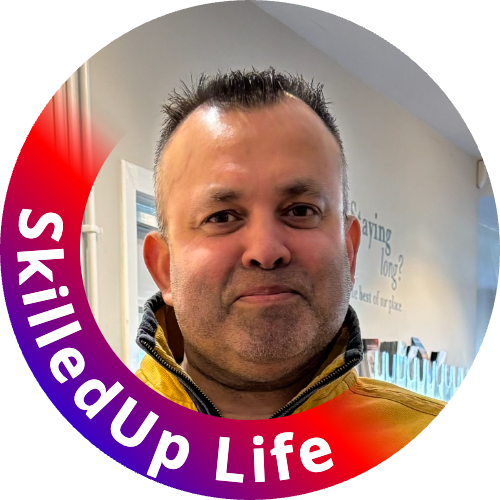
Manoj Ranaweera
Manoj has been building tech startups and related ventures since 2004 (22 yrs). He founded SkilledUp Life to address his own problem and we continue to be the most demanding customer of our own product.